Building Empathy and Connection through Relational-Cultural Theory
Modern neuroscience confirms that relationships are central to human growth, validating nearly all of the early tenets of Relational-Cultural Theory, including relational development, the neuroscience of connection, and the pursuit of social justice. Recognized by the American Psychological Association as one of the ten most influential psychological theories in North America, RCT offers a groundbreaking perspective on the power of connection.
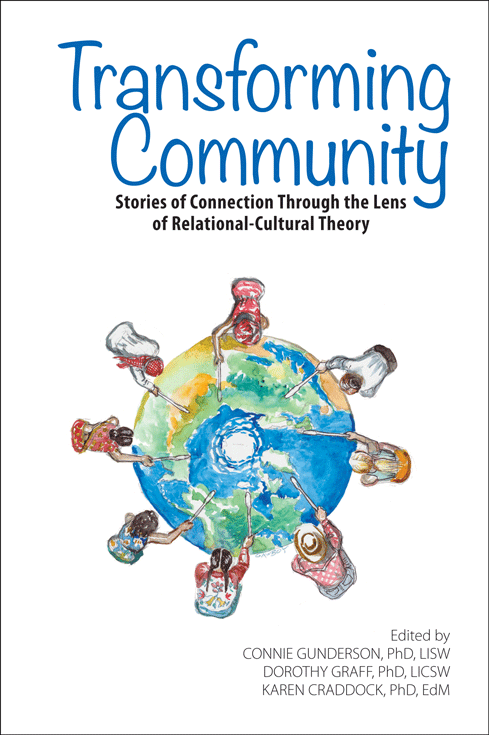
Transforming Community: Stories of Connection through the Lens of Relational-Cultural Theory brings together leading voices exploring how RCT transforms education, health care, the environment, and social justice. Edited by Connie Gunderson, PhD, LISW, Dorothy Graff, PhD, LICSW, and Karen Craddock, PhD, EdM, this collection emerged from the Transforming Community: The Radical Reality of Relationships conference held in Duluth, Minnesota, co-sponsored by The College of St. Scholastica, the Wellesley Centers for Women, and the Jean Baker Miller Training Institute at Wellesley College.
Applying RCT Across Disciplines
This book explores the transformative applications of RCT in a wide range of fields:
-
Neuroscience and healthcare, where empathy and connection are linked to healing and well-being.
-
Education, emphasizing belonging, mentoring, and mutual learning as pathways to equity.
-
Environment, highlighting the interdependence between people and the natural world.
-
Social justice, addressing privilege, race, advocacy, and the resilience born from mutual empathy.
Each section expands the conversation about connection, empathy, and inclusivity, inviting professionals and communities to deepen their understanding of relational growth.
What is Relational-Cultural Theory?
Developed in the late 1970s by Jean Baker Miller, MD; Irene Stiver, PhD; Janet Surrey, PhD; and Judith Jordan, PhD, Relational-Cultural Theory positions connection, not autonomy, as the foundation of human development.
When individuals are isolated, the pain they experience follows the same neural pathways as physical pain. RCT emphasizes that we grow through and toward connection, not apart from it. By cultivating mutual empathy and shared empowerment, this approach celebrates bridges over barriers and strengthens both individuals and communities.
Why This Book Matters
Transforming Community provides a hopeful and research-based framework for creating more empathic and inclusive relationships. It encourages readers to apply RCT principles to professional and personal settings, fostering resilience, combating isolation, and inspiring meaningful change. Whether you are a therapist, educator, activist, or leader, this book will help you understand how connection can transform communities.
Readers who appreciate this title may also find value in Resilient and Sustainable Caring, The Power of Story, and The Complete Caregiver Support Guide. Each resource explores resilience, empathy, and the importance of connection in helping professions and community work.
Frequently Asked Questions
Who is this book for?
It is ideal for mental health professionals, educators, researchers, and community leaders seeking to build inclusive, connected environments.
How does this book differ from traditional psychology texts?
It integrates neuroscience, social theory, and real-life narratives to present a holistic, relationship-centered model of growth.
Can it be used in classroom or training environments?
Yes. The essays and case studies make it highly relevant for academic, counseling, and social justice programs.
Contributors
ASPEN ABRAHAMSON-TAYLOR
AMY ANDERLY-DOTSON, MSW
AMY BANKS, MD
INDERJIT (VICKY) BASRA, LMSW
KAREN CRADDOCK, PhD, EdM
CYNTHIA RENEE DONNER, MSW, LGSW
CORRIE EHRBRIGHT, MSW
LISA EIBLE, DSW, MSW, LCSW
LOUISA D. FOOTMAN, PhD, LCSW-C
CARL GAWBOY
CONNIE GUNDERSON, PhD, LISW
TAYLOR GUNDERSON
MARY A. HERNANDEZ
NATALIE ARCE INDELICATO, PhD
JUDITH JORDAN, PhD
JULIE KIM, MSW, LICSW
ANTHONY KLAR, MSW
JANE LARSON, MSW, LGSW
NICOLE LELAND
AMY C. MAKICE, MSW, LCSW
ELIZABETH (LIBBY) MARLATT-MURDOCH, LPCA, LCAS-A, CTRTC, CCTP
BETSY B. NORDELL
VANESSA PATINO LYDIA, MPA
LEAH PRUSSIA, MSW, LICSW
ZARYN PRUSSIA
LAWANDA RAVOIRA, PhD
MATTHEW RIDER BARCLAY
HARRIET L. SCHWARTZ, PhD
KRISTEN SHREWSBURY, PhD
NATALIA SOLER
VANESSA THOENNES, MSW
ASHLEY TUVE, MSW
MARY URSULA VICARIO
OLIVIA VINNES
WILL WALES, MSW
MAUREEN WALKER, PhD