Practical Tools for Coping with Domestic Violence
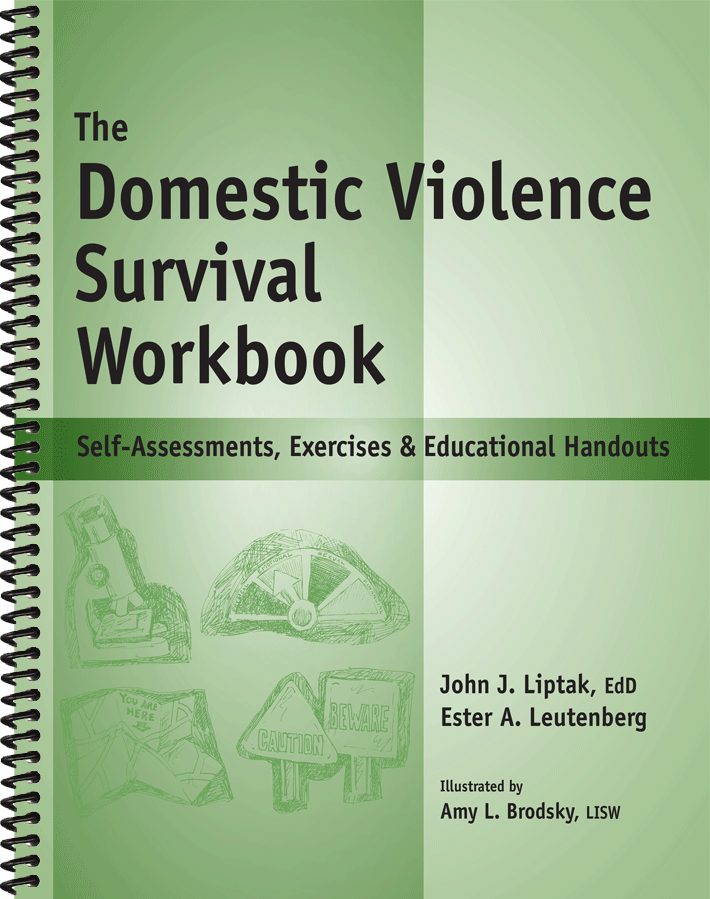
The Domestic Violence Survival Workbook provides therapists, counselors, educators, and group facilitators with reproducible domestic violence worksheets, self-assessments, and journaling activities to help individuals recognize, reflect on, and cope with abusive relationships. This workbook combines two powerful practices, self-assessment and journaling, which are proven to support awareness, healing, and long-term recovery.
Domestic violence can involve physical, emotional, psychological, sexual, verbal, or financial abuse. This resource acknowledges that abuse affects individuals across all ages, cultures, and backgrounds. Learning to recognize warning signs and practicing coping skills are important steps toward recovery and empowerment.
Why This Domestic Violence Workbook Works
-
Reproducible self-assessments and worksheets: Help survivors recognize how abuse is affecting their bodies, emotions, thoughts, and relationships.
-
Comprehensive sections:
-
Symptoms of Abuse — explore how abuse impacts physical health, emotional wellbeing, and mental clarity.
-
Types of Abuse — examine abusive behaviors across families, friendships, and workplaces; includes a 10-page safety plan.
-
Partner Behavior — identify controlling or manipulative patterns in relationships.
-
Elder Abuse — provide tools and validation for older adults facing abuse.
-
Self-Empowerment — support survivors in reclaiming autonomy and moving forward with confidence.
-
Therapeutic journaling prompts: Encourage reflection and provide a safe way to process emotions.
-
Professional guidance: Clear facilitator notes make it easy to use activities with individuals, in groups, or as part of a larger curriculum.
Who Will Benefit from This Resource
-
Therapists and counselors working with survivors of abuse.
-
Group facilitators and educators teaching about safe and healthy relationships.
-
Social workers and case managers supporting clients in recovery.
-
Community leaders, clergy, and advocates helping survivors rebuild.
-
Individuals who want tools for recognizing abuse, reflecting on their experiences, and moving forward.
 A Companion Domestic Violence Survival Card Deck for Deeper Conversations
Pair The Domestic Violence Survival Workbook with the Domestic Violence Survival Card Deck.
Using the Discussion Starter Card Deck will break the ice, encourage openness, and help introduce a specific subject. Activity handouts included in these workbooks are reflective, easy-to-use exercises, presented in a variety of formats to accommodate multiple intelligences and different learning styles. Each question corresponds to a page in the workbook.
Sample Questions
-
Ask others in the room their definition of domestic violence. Afterwards, share: Domestic violence is defined as a pattern of abusive behaviors by one partner against another in an intimate relationship.
-
How does your partner try to control you by imposing opinions and a worldview on you?
-
What keeps you dependent emotionally on your partner or other people?
Take the Next Step Toward Healing and Empowerment
The Domestic Violence Survival Workbook gives professionals and individuals reproducible tools that encourage reflection, self-awareness, and empowerment. Available in print or as a PDF eBook, it is practical and easy to integrate into therapy sessions, groups, classrooms, or individual use.
Frequently Asked Questions About The Domestic Violence Survival Workbook
Can this workbook be used in group settings?
Yes. The reproducible worksheets and activities are designed for therapy groups, classrooms, and workshops.
Is it appropriate for individual use?
Absolutely. Survivors can use the self-assessments and journaling prompts independently to gain insight and strengthen coping skills.
Does it include safety planning?
Yes. One section contains a detailed 10-page safety plan to help participants prepare for and manage dangerous situations.
Can it be part of a larger program?
Yes. Each section can be used individually, combined, or built into a more comprehensive domestic violence curriculum.